

For most of us, the routine is the same. Once a year, we do a blood test. A panel comes back with thirty or forty numbers. The doctor circles two of them, or the lab report underlines them: watch your cholesterol, your vitamin D is a bit low. The appointment ends, and the thought of I need to take this seriously arises briefly and then fades. A few days later we’ve moved past it. Twelve months later, we do it all over again.
If we’re more curious, we might also have done a DNA test from one of the consumer brands. A kit arrives, we spit in a tube, and a colourful report comes back telling us about ancestry, whether we taste bitter foods, or whether we’re likely to have curly hair. Interesting, sometimes amusing, almost never useful for an actual health decision. For most people in their 30s, 40s, and 50s, this is what knowing your health looks like. It’s a small fraction of what’s actually possible, and worse, the picture it gives can be quietly misleading.
The future of personalised medicine isn’t just about having more data; it’s about having the right data, integrated and interpreted intelligently. This blog post (#73) describes an approach we’ve been building together at GenePath Diagnostics and PreventiveHealth.ai that triangulates your health using three powerful tools. It’s co-authored with my friend and co-conspirator at GenePath Diagnostics, Dr. Nikhil Phadke. (Yes, we’re both Ni(c)khils, with a slight difference in our spellings; think of us as the Tintin comic characters Thomson and Thompson.)
Three things worth knowing about your body
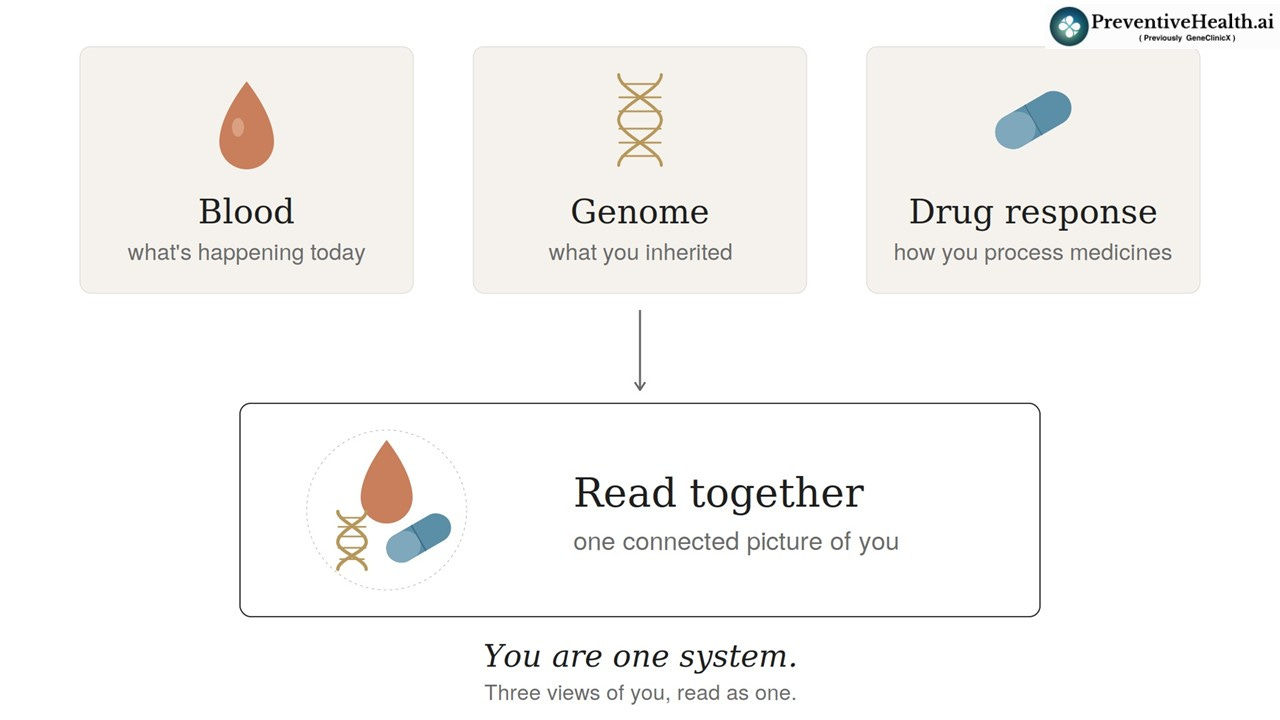
Let’s start with a simple way to think about our bodies. There are three layers, with each one showing us something the others can’t.
What’s happening inside you right now, circulating in your blood, picked up by the markers your annual panel measures.
What you inherited, the genetic blueprint that shaped how your body would handle things like cholesterol or insulin, long before you ever made a single choice about how to live.
How your body responds to medicines, a third dimension that’s also written into your DNA, but almost never looked at in ordinary care.
Each of these answers a question the others can’t. Read together, they paint an integrated picture that is more actionable. Let’s dig a little deper into each layer.
Layer one: your blood
Your annual blood test is a snapshot of how your body is functioning today. A modern panel covers more than 80 markers: your heart, liver, kidneys, blood sugar, hormones, inflammation, vitamins. It’s the most accessible window into your health and, for most of us, the only one we use.
But it has two big blind spots. The numbers are interpreted against population averages, when what you really want to know is whether they’re normal for you. And blood markers tell you what’s happening today, not why. Two people with identical numbers can be on completely different paths, one heading toward a problem, the other not, and the blood test alone can’t tell them apart.
Lifestyle (diet, exercise, sleep, weight, stress) is the foundation here, no matter what comes next. Often it’s enough to bring a number back into range. But sometimes it isn’t, and it is important to know when you are in that situation. And that’s the moment the next layer earns its place.
Layer two: your genes
The reason a blood marker won’t move despite your effort is often hiding in your DNA. A borderline high cholesterol can be perfectly fixable through lifestyle. Or it can be the result of a genetic pattern that makes your liver clear cholesterol slowly, keeping the number high no matter what you eat. The number on the blood report looks identical. The plan is completely different. Without your genome, you’re guessing whether your effort is going to be enough or whether you’ll need something more.
This suggests a genetic test is worth doing. But this is where most people get tripped up by the kind of genetic test to do. Most consumer DNA brands use a method called genotyping, which scans a few hundred thousand pre-selected positions in your DNA, chosen for ancestry estimates and traits like whether you taste cilantro as soap. These tests are quite interesting. However, they were never designed to inform clinical decisions, and the questions above usually involve variants outside what genotyping is built to find.
The kind of test that does work for clinical questions is whole exome sequencing, reading every protein-coding gene in your genome. It’s a different category of test entirely, and the same technology hospitals use to diagnose rare disease and guide cancer treatment. Reading it well requires clinical and genomic specialists working together over many years to bridge the gap between we found a variant and here’s what it means for your health.
Layer three: how your body handles medicines
If your blood plus your genes together say that lifestyle alone won’t get you to target, the conversation moves to medication. And here a third layer matters, one almost nobody measures. Pharmacogenomics asks how your body will respond to medicines, given your genes.
Two people on the same dose of the same drug can respond very differently. Codeine isn’t actually a painkiller when it leaves the bottle; your liver has to convert it, and roughly one in twelve people can’t. The same is true for statins, blood thinners, antidepressants, common chemotherapies, and dozens of other medicines. A pharmacogenomic test tells your doctor, in advance, which drugs will work for you and where the dose needs adjusting. The information already exists in your DNA. It’s rarely looked at.
The full picture
Lifestyle first, always. Blood markers tell you what’s happening; your genes tell you whether lifestyle alone will get you there; pharmacogenomics tells you which medicine and dose to use if it doesn’t. Three layers, not in competition, each earning its place in turn.
Almost no one’s care today integrates all three. That’s the gap. And it’s where things start to get interesting.
Below are a few examples of what interpreting all three together does. These are real cases we’ve run in our lab on real consumers, each showing what a fragmented report would have missed.
The consumer whose “genetic” low HDL turned out not to be genetic
A 52-year-old man had been told for years that his unusually low HDL (the so-called good cholesterol) was just how his body was built. It runs in your family. It’s genetic. Don’t worry about it. His HDL had sat as low as 6 mg/dL, around a seventh of where it should be. Multiple doctors, multiple panels, the same answer. He stopped trying to change it.
When his blood, whole exome, and drug-response profile were finally read together, that story collapsed.
His exome did not show the genetic pattern that explains very low HDL on its own. What the integrated reading did show was a metabolic picture his standard cholesterol report had missed: triglycerides at 283 mg/dL, elevated fasting insulin, and an insulin resistance index well above threshold. His HDL wasn’t being suppressed by his genes. It was being suppressed by an insulin-resistant metabolism nobody had connected to his cholesterol report. His statin had been doing its narrow job, keeping his LDL at goal, while masking the real story underneath.
He started addressing the metabolic root cause. His HDL has now risen from 6 to 15 mg/dL over the last month, which matters less in itself than what it signals. The metabolic engine that was driving it down is finally being addressed. He’s still well below the 40 mg/dL minimum, and this isn’t a fixed problem. But the trajectory has reversed for the first time in years, and the underlying picture is moving in the same direction.
The integrated report flagged one more thing. A variant in a liver enzyme called CYP2C19 means clopidogrel, the standard blood thinner given after a heart attack, stroke, or stent, would not activate properly in his body. At 52, with active cardiovascular risk, knowing this before an emergency means a future cardiologist can prescribe an alternative without having to figure it out under pressure. The information now sits in his medical record, not waiting to be discovered after the fact.
Two findings, two different layers, one report. Neither would have been visible without the others.
The athlete whose effort wasn’t being rewarded
The opposite case. A 35-year-old elite athlete trained 12 to 15 hours a week. Her blood report showed HDL of 38, below the female cutoff of 50, and LDL of 141, well above target. By every standard expectation of what exercise does to cholesterol, her numbers should have been textbook. They were not.
Most doctors would tell her to exercise more, eat cleaner, and lose weight. She was already exercising more than 99% of the population, with nothing left to give on lifestyle, and was starting to wonder whether her body was just built differently. Whether this was, in the end, genetic.
Interpreted in the context of her genome and her hormonal profile, the actual driver was clear: PCOD-related hormonal imbalance was suppressing her HDL and pushing her LDL up. Exercise wasn’t the lever. The right intervention wasn’t in the gym; it was in a gynaecologist’s office, addressing the hormonal source.
Her pharmacogenomic profile then surfaced something else worth knowing in advance, given a strong family history of early-onset breast cancer on both sides of her family. She carries a variant that means tamoxifen, the drug most commonly prescribed for a type of breast cancer driven by hormones, would not activate properly in her body. If she ever needed the treatment, an oncologist would need to prescribe a different type of medication called an aromatase inhibitor from the start. She doesn’t have breast cancer. The point of putting this on file is that it’s there before it’s ever needed.
Her case was the mirror image of the first. He had been told a fixable problem was genetic. She was about to start telling herself a genetic problem was a lifestyle failure. Both errors were avoidable.
My (Nikhil’s) own report: two surprises in one integrated analysis
The third case is mine. Two findings stood out, neither of which I could have predicted from any single layer.
The first concerned my homocysteine, an amino acid linked to cardiovascular risk. Mine came back at 17.14 µmol/L, well above the cardiovascular-optimal target of under 10. The standard medical response to a result like this is straightforward: take a folic acid supplement, the body breaks down homocysteine, the number comes down. No physician would be wrong to prescribe that.
But my exome showed a variant called MTHFR C677T, which makes it hard for my body to convert standard folic acid into the active form, methylfolate, which the body uses to break down homocysteine. Standard folic acid would likely not have brought my number down, and could have left me no better off. The integrated reading meant I knew, before any prescription, that I specifically needed methylfolate, the form that bypasses the genetic bottleneck. Just a few weeks after a switch from folic acid to methyl folate, my homocysteine levels are now down to 14.75 µmol/L. Same goal, different supplement, because of a variant a blood report alone could never have surfaced.
The second concerned my cholesterol. Total cholesterol of 240 mg/dL, LDL of 176 mg/dL, well above target. The default advice for numbers like these is eat better, exercise more. I was already exercising intensely and eating well. The exome showed mutations in two of my genes, which together make my body slower at clearing LDL, corroborated by cardiovascular history on both sides of my family. Diet alone was unlikely to be enough.
Then the integrated reading flagged a potential complication. My blood work showed a mildly elevated CPK (345 U/L) value, an enzyme that hints at muscle sensitivity. Furthermore, my pharmacogenomic profile carried an ABCB1 variant associated with higher risk of statin-related muscle symptoms. Three layers, one consistent message: I likely needed pharmacological help to reach my LDL target, and a standard statin was not the cleanest first option for me. My cardiologist and I discussed using an alternative option - a combination of bempedoic acid and ezetimibe, which lower cholesterol through different pathways and are less likely to affect muscles. The trial-and-error, a typical first prescription involves, can be skipped because the relevant biology was visible from the start. Just a few weeks after the initiation of the bempedoic acid and ezetimibe combination, my total cholesterol is now down to 165 mg/dL and LDL is at 94 mg/dL - both within desirable range.
Conclusion so far … and the road ahead
What an integrated view like this does is to bring these individual established pieces into the same conversation, at the same time, for the same person. You can imagine where this can go next. Integrate your wearable data, your body composition analysis from your InBody Scan or Dexa reports, your brain scans, your stress test data, etc. We are not inventing new science but rather stopping the existing science from being lost in the gaps between specialists. And most of what comes back is reassuring. The point isn’t to alarm, it’s to confirm what you already suspected was fine, catch the small number of things that aren’t while there’s still time to act, and tell you which of those things are genuinely genetic and which aren’t. So you stop fighting what you can’t change, focus on what you can and start acting on those. We are one system and we need to start analyzing our reports accordingly.
Bringing it to life: Mira-One
This is exactly what we’ve built into Mira One: a single integrated report from PreventiveHealth.ai and GenePath Diagnostics that brings your blood, exome, and drug-response profile into one connected picture. Many of us within our company, who’ve run our own reports, have uncovered insights we had missed for years, and were able to act on them. Kudos to our team of geneticists, clinicians, and analysts who have been at this for more than a decade in putting the pieces of this together. We will officially unveil Mira One at the ImagiNxt conference in Mumbai, where I will be speaking on May 23rd at 2:30 pm on the role of AI and trust in healthcare. If you are around, come drop by to say hi!
If this kind of report would help you or your family, you can learn more here
Disclaimer: The information provided in this article is for educational and informational purposes only. It is not intended as a substitute for professional medical advice, diagnosis, or treatment. Always seek the advice of your physician or other qualified healthcare providers with any questions you may have regarding a medical condition or wellness program. Reliance on any information provided in this article is solely at your own risk. The author and publisher of this article make no representations or warranties, express or implied, regarding the completeness, accuracy, reliability, suitability, or effectiveness of the information contained herein. The inclusion of specific products, services, or strategies in this article does not imply endorsement or recommendation. The author and publisher disclaim any liability for any adverse effects or consequences resulting from the use or application of the information presented. You are encouraged to consult with a qualified healthcare professional before making any changes to your diet, exercise routine, or lifestyle.


